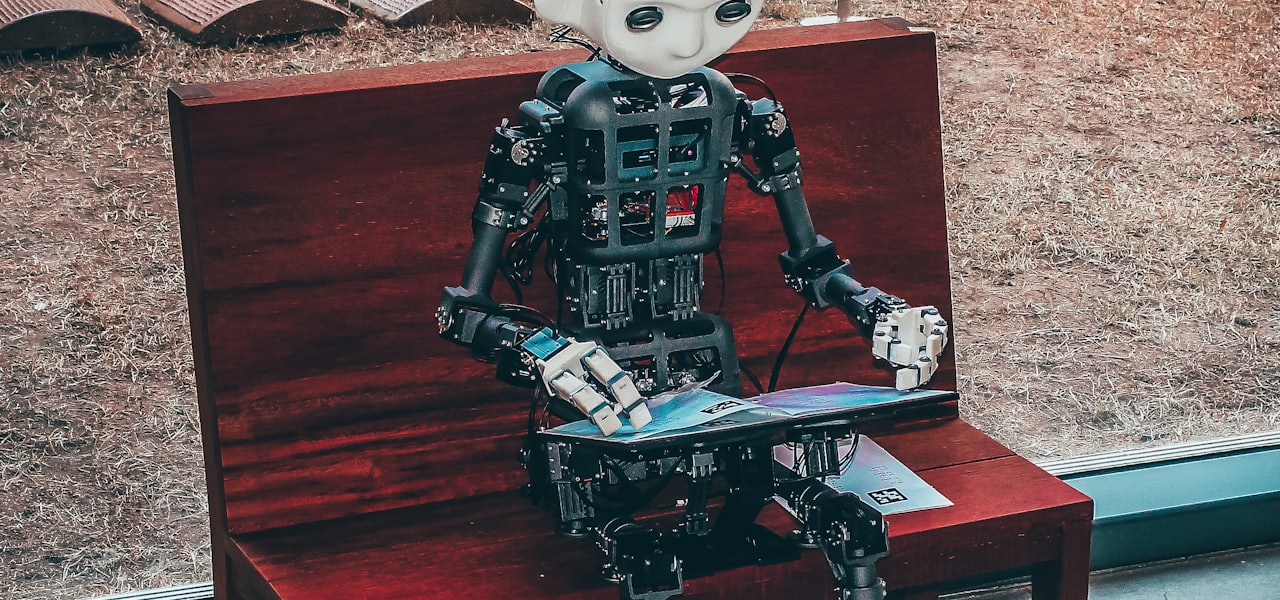
Freddy (1969–1971) and Freddy II (1973–1976) were experimental robots built in the Department of Machine Intelligence and Perception (later Department of Artificial Intelligence, now part of the School of Informatics at the University of Edinburgh). == Technology == Technical innovations involving Freddy were at the forefront of the 70s robotics field. Freddy was one of the earliest robots to integrate vision, manipulation and intelligent systems as well as having versatility in the system and ease in retraining and reprogramming for new tasks. The idea of moving the table instead of the arm simplified the construction. Freddy also used a method of recognising the parts visually by using graph matching on the detected features. The system used an innovative collection of high level procedures for programming the arm movements which could be reused for each new task. == Lighthill controversy == In the mid 1970s there was controversy about the utility of pursuing a general purpose robotics programme in both the USA and the UK. A BBC TV programme in 1973, referred to as the "Lighthill Debate", pitched James Lighthill, who had written a critical report for the science and engineering research funding agencies in the UK, against Donald Michie from the University of Edinburgh and John McCarthy from Stanford University. The Edinburgh Freddy II and Stanford/SRI Shakey robots were used to illustrate the state-of-the-art at the time in intelligent robotics systems. == Freddy I and II == Freddy Mark I (1969–1971) was an experimental prototype, with 3 degrees-of-freedom created by a rotating platform driven by a pair of independent wheels. The other main components were a video camera and bump sensors connected to a computer. The computer moved the platform so that the camera could see and then recognise the objects. Freddy II (1973–1976) was a 5 degrees of freedom manipulator with a large vertical 'hand' that could move up and down, rotate about the vertical axis and rotate objects held in its gripper around one horizontal axis. Two remaining translational degrees of freedom were generated by a work surface that moved beneath the gripper. The gripper was a two finger pinch gripper. A video camera was added as well as later a light stripe generator. The Freddy and Freddy II projects were initiated and overseen by Donald Michie. The mechanical hardware and analogue electronics were designed and built by Stephen Salter (who also pioneered renewable energy from waves (see Salter's Duck)), and the digital electronics and computer interfacing were designed by Harry Barrow and Gregan Crawford. The software was developed by a team led by Rod Burstall, Robin Popplestone and Harry Barrow which used the POP-2 programming language, one of the world's first functional programming languages. The computing hardware was an Elliot 4130 computer with 384KB (128K 24-bit words) RAM and a hard disk linked to a small Honeywell H316 computer with 16KB of RAM which directly performed sensing and control. Freddy was a versatile system which could be trained and reprogrammed to perform a new task in a day or two. The tasks included putting rings on pegs and assembling simple model toys consisting of wooden blocks of different shapes, a boat with a mast and a car with axles and wheels. Information about part locations was obtained using the video camera, and then matched to previously stored models of the parts. It was soon realised in the Freddy project that the 'move here, do this, move there' style of robot behavior programming (actuator or joint level programming) is tedious and also did not allow for the robot to cope with variations in part position, part shape and sensor noise. Consequently, the RAPT robot programming language was developed by Pat Ambler and Robin Popplestone, in which robot behavior was specified at the object level. This meant that robot goals were specified in terms of desired position relationships between the robot, objects and the scene, leaving the details of how to achieve the goals to the underlying software system. Although developed in the 1970s RAPT is still considerably more advanced than most commercial robot programming languages. The team of people who contributed to the project were leaders in the field at the time and included Pat Ambler, Harry Barrow, Ilona Bellos, Chris Brown, Rod Burstall, Gregan Crawford, Jim Howe, Donald Michie, Robin Popplestone, Stephen Salter, Austin Tate and Ken Turner. Also of interest in the project was the use of a structured-light 3D scanner to obtain the 3D shape and position of the parts being manipulated. The Freddy II robot is currently on display at the Royal Museum in Edinburgh, Scotland, with a segment of the assembly video shown in a continuous loop.
AstroPay
AstroPay is a global digital wallet that provides users with a way to pay, send, and receive money. The app provides online payments, virtual and physical debit cards, peer-to-peer money transfers, and more. == History == AstroPay was founded in Uruguay in 2009 as a payment processing company. Over time, it expanded its services across Latin America, EMEA, and APAC. A significant milestone occurred in 2016, when AstroPay spun off dLocal, focusing on cross-border payments for emerging markets. dLocal became Uruguay's first unicorn and eventually went public through a successful IPO. In 2020, AstroPay spun off its payment processing services into a new entity, D24, to focus on mobile wallet for cross border. Between 2023 and 2024 the Company brought new leadership to guide its transition towards becoming a fully focused global digital multicurrency wallet where users save, send, and spend globally. This shift introduced enhanced features, including loyalty prepaid cards and multicurrency accounts. == Services == AstroPay offers three main products: AstroPay Wallet, AstroPay check-out, and AstroPay Platform. AstroPay Wallet is a digital wallet for consumers, where they have multicurrency accounts, prepaid card and marketplace. With AstroPay check-out, businesses can tap into AstroPay's wallet user base by accepting AstroPay as a payment method in their check-out options. Lastly, AstroPay Platform enables other businesses to use the AstroPay network to launch their own global wallet. == Brand endorsements, partnerships == AstroPay's marketing strategy has included the development of co-branded products with sports teams and other brand. The company sponsored Burnley Football Club during the 2018–19 Premier League season, renewing the partnership for the 2021–22 Premier League season when it became the club's official payment service partner. In August 2021, AstroPay entered into a partnership with the Wolverhampton Wanderers for the 2021-22 Premier League season, and the following year, became the team's shirt sponsor. Later, in September 2021, AstroPay expanded its partnership with Wolverhampton Wanderers, which included becoming the team's official payment partner and later, in 2023, co-launching a co-branded card. Other partnerships include Newcastle United in 2021 in the English Premier League. AstroPay made arrangements to ensure that branding and logo would be visible on the pitch-side LED advertising during Premier League matches. Furthermore, in June 2022, the company renewed it's partnership with Wolverhampton Wanderers for the 2022-23 Premier League season and launched its Wolves debit card in February 2023. Some other notable partnerships include: Universidad de Chile in 2024, Tottenham Hotspurs in 2023-25, and even a collaboration with Lionel Messi across all of Latin America. == Recent developments == AstroPay has refocused its strategy since 2023, pivoting from payment processing to concentrate on its global digital wallet. This move reflects a broader effort to redefine the company's market positioning by emphasizing global user-friendly financial services, while separating its identity from previous operations managed by dLocal and D24.
Illia Polosukhin
Illia Polosukhin is a Ukrainian-born computer scientist and entrepreneur known for his work on the transformer architecture in machine learning and for co-founding the NEAR blockchain. == Early life and education == Polosukhin studied at the Kharkiv Polytechnic Institute, later relocating to San Diego and then moving to Silicon Valley. == Career == === Google and transformer research === Polosukhin worked at Google and was part of the team associated with research on self-attention that culminated in the 2017 paper Attention Is All You Need, widely credited with introducing the transformer architecture used in modern large language models. === NEAR Protocol === After his work in machine learning, Polosukhin became a co-founder of NEAR Protocol and later associated with the NEAR Foundation ecosystem. In 2023, Polosukhin publicly argued that increasingly capable A.I. systems should be more transparent and user-controlled, and expressed skepticism that conventional regulation alone would solve problems created by closed, corporate models, warning about risks such as regulatory capture. He has promoted “user-owned AI” concepts that combine open approaches with decentralized infrastructure aligned with the blockchain technology. In 2024, Polosukhin downplayed scenarios of A.I. independently causing human extinction, arguing that conflicts are driven by people and that misuse of AI would reflect human intent and incentives. Later this year, Polosukhin said the NEAR Foundation would reduce its workforce by about 40%. == Publications == Noam Shazeer, Niki Parmar, Jakob Uszkoreit, Lukasz Kaiser, Illia Polosukhin; et al. (2017). "Attention Is All You Need". arXiv.{{cite journal}}: CS1 maint: multiple names: authors list (link)
Microelectronics and Computer Technology Corporation
Microelectronics and Computer Technology Corporation, originally the Microelectronics and Computer Consortium and widely seen by the acronym MCC, was the first, and at one time one of the largest, computer industry research and development consortia in the United States. MCC ceased operations in 2000 and was formally dissolved in 2004. == Divisions == MCC did research and development in the following areas: [1] System Architecture and Design (optimise hardware and software design, provide for scalability and interoperability, allow rapid prototyping for improved time-to-market, and support the re-engineering of existing systems for open systems). Advanced Microelectronics Packaging and Interconnection (smaller, faster, more powerful, and cost-competitive). Hardware Systems Engineering (tools and methodologies for cost-efficient, up-front design of advanced electronic systems, including modelling and design-for-test techniques to improve cost, yield, quality, and time-to-market). Environmentally Conscious Technologies (process control and optimisation tools, information management and analysis capabilities, and non-hazardous material alternatives supporting cost-efficient production, waste minimisation, and reduced environmental impact). Distributed Information Technology (managing and maintaining physically distributed corporate information resources on different platforms, building blocks for the national information infrastructure, networking tools and services for integration within and between companies, and electronic commerce). Intelligent Systems (systems that "intelligently" support business processes and enhance performance, including decision support, data management, forecasting and prediction). == History == The MCC was a response to the announcement of Japan's Fifth Generation Project, a large Japanese research project launched in 1982 aimed at producing a new kind of computer by 1991. The Japanese had formed similar industrial research consortia as early as 1956.[2] Many European and American computer companies saw this new Japanese initiative as an attempt to take full control of the world's high-end computer market, and MCC was created, in part, as a defensive move against that threat. In late 1982, several major computer and semiconductor manufacturers in the United States banded together and founded MCC under the leadership of Admiral Bobby Ray Inman, whose previous positions had been Director of the National Security Agency and deputy director of the Central Intelligence Agency. Such formations were illegal in the United States until the 1984 Congressional passage of the "National Cooperative Research Act". Several sites with relevant universities were considered, including Atlanta, Georgia (Georgia Tech), the Research Triangle, N.C. (UNC), the Washington, D.C. area (George Mason), Stanford University and Austin, Texas (UT) which was the final selection. The University of Texas offered land upon which they would construct a new building specifically designed for the MCC within their Austin campus. Ross Perot also offered the use of his private plane for 2 years for staff recruitment. Austin was selected as the site for MCC in 1983. Despite this purpose and the background of Inman and his senior staff, MCC accepted no government funding for many years and was a refuge for some avoiding work on Strategic Defense Initiative projects. MCC was part of the Artificial Intelligence boom of the 1980s, reportedly the single largest customer of both Symbolics and Lisp Machines, Inc. (and like Symbolics, was one of the first companies to register a .com domain). In the 1980s its major programs were packaging, software engineering, CAD, and advanced computer architectures. The latter comprised artificial intelligence, human interface, database, and parallel processing, the latter two merging in the late 1980s. Many of the early shareholder companies were mainframe computer companies under stress in the 1980s. Over the years, MCC's membership diversified to include a broad range of high-profile corporations involved in information technology products, as well as government research and development agencies and leading universities. In June, 2000 the MCC Board of Directors voted to dissolve the consortium, and the few remaining employees held a wake at Scholz's Beer Garden in Austin on October 25. Formal dissolution papers were reportedly not filed until 2004. == Spinoffs == While multiple technologies were transferred to member companies and government agencies in the final years, fourteen companies were spun out of MCC. Those spinoffs include: TeraVicta Technologies, Austin's first MEMS company; its focus was to develop microscopic switch technology for fiber optic switching and radiofrequency switching in mobile phones specifically to dynamically switch between the future 3G-4GLTE-future5G wireless communication frequencies and ensure mobile phones were communicating over the strongest wireless signal to reduce dropped calls. Robert Miracky was the founding CEO who spun out the first commercial metal micromachining technology developed by MCC researchers Brent Lunceford, Jason Reed, Richard Nelson, K.Hu, and C. Hilbert in a collaborative development program with IBM in a novel implementation and operational paradigm for solid-state integrated circuit coolers integrated with conductive MEMS switches. TeraVicta was liquidated under Chapter 7 bankruptcy proceedings in 2015. The Austin region subsequently built up a MEMS & Sensors value chain in the billions of dollars comprising companies such as 3M, Cypress Semiconductor, NXP Semiconductor, Cirrus Logic, Silicon Labs, and the Austin division of the now-defunct Silicon Valley Technology Center. Portelligent, a company that provides reverse engineering teardown services. At the time, Portelligent was the first company to commercialize such services; they had been provided by MCC to its member companies. Today, there are at least twelve companies worldwide that sell reports known as "reverse engineering teardown reports." Modern day teardown reports provide detailed information about technology products such as the bill of materials, microchip, and printed circuit board design specifics, manufacturing details including manufacturing location details for the entire value chain responsible for making electronics, including the iPhone and Samsung Galaxy smartphones. Portelligent was acquired by CMP Technology in 2007. Evolutionary Technologies International, a company focused on developing database tools and data warehousing. It was spun off from MCC in 1990.
Unique name assumption
The unique name assumption is a simplifying assumption made in some ontology languages and description logics. In logics with the unique name assumption, different names always refer to different entities in the world. It was included in Ray Reiter's discussion of the closed-world assumption often tacitly included in Database Management Systems (e.g. SQL) in his 1984 article "Towards a logical reconstruction of relational database theory" (in M. L. Brodie, J. Mylopoulos, J. W. Schmidt (editors), Data Modelling in Artificial Intelligence, Database and Programming Languages, Springer, 1984, pages 191–233). The standard ontology language OWL does not make this assumption, but provides explicit constructs to express whether two names denote the same or distinct entities. owl:sameAs is the OWL property that asserts that two given names or identifiers (e.g., URIs) refer to the same individual or entity. owl:differentFrom is the OWL property that asserts that two given names or identifiers (e.g., URIs) refer to different individuals or entities.
Supersampling
Supersampling or supersampling anti-aliasing (SSAA) is a spatial anti-aliasing method, i.e. a method used to remove aliasing (jagged and pixelated edges, colloquially known as "jaggies") from images rendered in computer games or other computer programs that generate imagery. Aliasing occurs because unlike real-world objects, which have continuous smooth curves and lines, a computer screen shows the viewer a large number of small squares. These pixels all have the same size, and each one has a single color. A line can only be shown as a collection of pixels, and therefore appears jagged unless it is perfectly horizontal or vertical. The aim of supersampling is to reduce this effect. Color samples are taken at several instances inside the pixel (not just at the center as normal)—hence the term "supersampling"—and an average color value is calculated. This can for example be achieved by rendering the image at a much higher resolution than the one being displayed, then shrinking it to the desired size, using the extra pixels for calculation, with the result being a downsampled image with smoother transitions from one line of pixels to another along the edges of objects, but each pixel could also be supersampled using other strategies (see the Supersampling patterns section). The number of samples determines the quality of the output. == Motivation == Aliasing is manifested in the case of 2D images as moiré pattern and pixelated edges, colloquially known as "jaggies". Common signal processing and image processing knowledge suggests that to achieve perfect elimination of aliasing, proper spatial sampling at the Nyquist rate (or higher) after applying a 2D Anti-aliasing filter is required. As this approach would require a forward and inverse fourier transformation, computationally less demanding approximations like supersampling were developed to avoid domain switches by staying in the spatial domain ("image domain"). == Method == === Computational cost and adaptive supersampling === Supersampling is computationally expensive because it requires much greater video card memory and memory bandwidth, since the amount of buffer used is several times larger. A way around this problem is to use a technique known as adaptive supersampling, where only pixels at the edges of objects are supersampled. Initially only a few samples are taken within each pixel. If these values are very similar, only these samples are used to determine the color. If not, more are used. The result of this method is that a higher number of samples are calculated only where necessary, thus improving performance. === Supersampling patterns === When taking samples within a pixel, the sample positions have to be determined in some way. Although the number of ways in which this can be done is infinite, there are a few ways which are commonly used. ==== Grid ==== The simplest algorithm. The pixel is split into several sub-pixels, and a sample is taken from the center of each. It is fast and easy to implement. Although, due to the regular nature of sampling, aliasing can still occur if a low number of sub-pixels is used. ==== Random ==== Also known as stochastic sampling, it avoids the regularity of grid supersampling. However, due to the irregularity of the pattern, samples end up being unnecessary in some areas of the pixel and lacking in others. ==== Poisson disk ==== The Poisson disk sampling algorithm places the samples randomly, but then checks that any two are not too close. The end result is an even but random distribution of samples. The naive "dart throwing" algorithm is extremely slow for large data sets, which once limited its applications for real-time rendering. However, many fast algorithms now exist to generate Poisson disk noise, even those with variable density. The Delone set provides a mathematical description of such sampling. ==== Jittered ==== A modification of the grid algorithm to approximate the Poisson disk. A pixel is split into several sub-pixels, but a sample is not taken from the center of each, but from a random point within the sub-pixel. Congregation can still occur, but to a lesser degree. ==== Rotated grid ==== A 2×2 grid layout is used but the sample pattern is rotated to avoid samples aligning on the horizontal or vertical axis, greatly improving antialiasing quality for the most commonly encountered cases. For an optimal pattern, the rotation angle is arctan (1/2) (about 26.6°) and the square is stretched by a factor of √5/2, making it also a 4-queens solution.
WYSIWYM (interaction technique)
What you see is what you meant (WYSIWYM) is a text editing interaction technique that emerged from two projects at University of Brighton. It allows users to create abstract knowledge representations such as those required by the Semantic Web using a natural language interface. Natural language understanding (NLU) technology is not employed. Instead, natural language generation (NLG) is used in a highly interactive manner. The text editor accepts repeated refinement of a selected span of text as it becomes progressively less vacuous of authored semantics. Using a mouse, a text property held in the evolving text can be further refined by a set of options derived by NLG from a built-in ontology. An invisible representation of the semantic knowledge is created which can be used for multilingual document generation, formal knowledge formation, or any other task that requires formally specified information. The two projects at Brighton worked in the field of Conceptual Authoring to lay a foundation for further research and development of a Semantic Web Authoring Tool (SWAT). This tool has been further explored as a means for developing a knowledge base by those without prior experience with Controlled Natural Language tools.